
Sermon 193- Khuṭbah Mutaqqīn [Part 2]
﷽
In the Name of Allah, the All-Beneficent, the All-Merciful
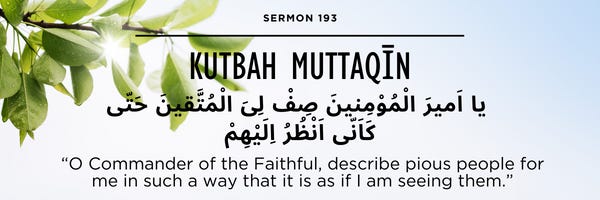
This week we continue our discussion on the Sermon of the Mutaqqīn, sermon number 193 of Nahj al-Balāghah.
As mentioned last week, Amīrul Muʾminīn (ʿa) delivered this sermon in response to Hammām's question and his persistent inquiry. The question asked by Hammām was “Describe pious people for me in such a way that it is as if I am seeing them.”
The question at hand holds great value as it facilitates progress, fosters enlightenment, and likely arises from thoughtful contemplation. Initially, Imam ʿAlī (ʿa) refrains from immediately addressing the question, perhaps with the intention of intensifying Hammām's eagerness to hear the answer, and allowing the Imām's words to have a more profound impact on him. At times, the frustration that arises from not receiving an immediate response can be both beautiful and beneficial. This sense of aggravation has the potential to lead to enlightenment, intensify one's thirst for knowledge, and prepare their heart and soul to truly comprehend the forthcoming answer.
Hammām asks for a description, he did not ask how to become pious; however, he asked the Imām (ʿa) to describe pious people for him. In spiritual wayfaring, we do not “reach Allah (swt)”, rather we “move toward Allah (swt)”. Some people ask how can they “reach” Allah (swt) so that they can reach a destiny and stop. We should be careful that our goal is not to find relief from the hardships that are part of traveling on this path. Agha Panahein eloquently expresses this sentiment in his book, “Do not escape from hardships. Announce to God, “I will stand firmly to the end!” Then you will see that your hardships continuously advance to a new, more exalted level. You will feel relieved from your previous hardships, and you will continue to move forward on this path!”1
In many cases, our problem is not that we don’t know the way, the problem is that we do not have enough motivation to move forward on this path. Hammām was clever, he asked for a description of pious people so that he could gain “motivation” and “enthusiasm” for becoming a pious person. We should thank Hammām for this beautiful question, as it is a huge blessing due to which we have these beautiful words of our Amīr (ʿa).
Our Imām (ʿa) starts his sermon by praising Allah (swt) and sending salutations and greetings to the Noble Prophet (ṣ). This is a common practice in many of Imām ʿAlī's (ʿa) sermons. Why is this so? Initiating with praise for Allah swt and salutations to the Messenger of God (ṣ) is an act of courtesy. It reflects the deep love and devotion one holds in their heart for Allah (swt) and His prophet (ṣ). It serves as a reminder to others and also functions as a declaration of one's faith.
اَمّا بَعْدُ، فَاِنَّ اللّهَ سُبْحانَهُ وَ تَعالى خَلَقَ الْخَلْقَ حینَ خَلَقَهُمْ غَنِیّاً عَنْ طاعَتِهِمْ، آمِناً مِنْ مَعْصِیَتِهِمْ، لاَنَّهُ لاتَضُرُّهُ مَعْصِیَةُ مَنْ عَصاهُ، وَ لاتَنْفَعُهُ طاعَةُ مَنْ اَطاعَهُ.
“God the Glorious, the Sublime, created all of creation. He created these without any need for their obedience and while being safe from their sinning. Because the sins of those who sin do not harm Him, nor does the obedience of anyone who obeys Him benefit Him.”
This statement reflects the immense greatness and magnificence of Allah (swt). It emphasizes that we cannot worship a god who lacks greatness. It is impossible for anyone to cause harm to Allah (swt). Some individuals mistakenly believe that by avoiding sin, they are doing Allah (swt) a favor and trying not to inconvenience Him. They fail to recognize that their sins have no impact on the majesty of Allah (swt).
Why did the Imām (ʿa) mention that Allah (swt) has no needs before discussing the attributes of pious individuals? It could be to ensure that no one misunderstands that their obedience and piety are meant to benefit Allah (swt), and that their lack of piety would harm Him.
The second introduction by Imām ʿAlī (ʿa):
فَقَسَمَ بَیْنَهُمْ مَعایِشَهُمْ، وَ وَضَعَهُمْ مِنَ الدُّنْیا مَواضِعَهُمْ. فَالْمُتَّقُونَ فیها هُمْ اَهْلُ الْفَضائِلِ
“So He has distributed their sustenance among them and He has put each person in the world where he or she should be. The pious have these superior virtues in this world.”
Imām ʿAlī (ʿa) emphasizes that from the beginning of creation, Allah swt created people differently. People vary in their inner characteristics, temperament, societal roles, and physical appearances. However, amidst these differences, one undeniable truth remains: everyone should strive for piety.
Our individual dispositions do not serve as obstacles to piety; in fact, they form the foundation for our divine tests. Allah (swt) will test us in a manner that reveals our inner nature. For instance, an ascetic person may be tested in a way that requires them to relinquish their ascetic practices, while an emotional person may face a test that necessitates controlling their emotions. God tailors our tests based on our unique dispositions. Piety is when we abandon a deed that is hard for us for the sake of Allah swt and also we do a deed that is difficult for us for the sake of Allah swt.
Imām ʿAlī (ʿa) may have mentioned the differences among people prior to discussing the qualities of pious individuals to remind us that despite our disparities, all of us have the potential to attain piety.
The definition of Taqwā (Piety)
We may have heard the definition of taqwā as avoiding, fearing, refraining, however, the meaning of taqwā is much more beautiful than this.
Agha Panahein mentions an example to start the definition of Taqwā (piety):
“Imagine a woman whose husband has been listed as missing at the war front. She still has hope he will return, so she takes care of herself and her children while remembering him. Whenever she cleans her house, she tells herself, "If my husband returns one day, IlI tell him, 'I took care of this house, our children and myself my whole life while waiting for you.' If he doesn't return, what I am doing is not to my detriment. It is still to my benefit." Is this way of taking care of oneself hard and bitter?”2
Piety entails protecting oneself for the sake of another. This safeguarding comprises three fundamental aspects:
1. Recognizing one's own worth and value.
2. Becoming acquainted with the ultimate goal and developing affection towards it.
3. Safeguarding oneself in pursuit of that goal.
An individual should first understand their own worth and recognize their inherent value. Next, they should acquire knowledge of Allah (swt) and comprehend His exalted position. Finally, the person grasps the significance of attaining the pinnacle of enjoyment in reaching Allah (swt). Consequently, they protect themselves in anticipation of that blissful moment of union with Allah (swt).
Imām ʿAlī (ʿa) said that pious people have superior virtues. He did not say that sometimes they have virtues. Goodness is constantly showered on them, and one can see the effect of this in their good behavior. For such people letting go of this world is not hard at all. A pious person has a fear and worry present within themselves which is actually very sweet. This fear is due to the importance of the goal and the love he has for it.
What are superior virtues?
After a brief introduction, our Imām stated that the pious possess exceptional virtues in this world. Having virtues means transforming one's flaws into strengths. These virtues are not the primary aim of pious individuals; rather, they are the natural outcome of their piety. Our focus should be on pursuing piety, and as we progress on this path, goodness and virtue will naturally emerge within us. The description of the pious by Imām ʿAlī (ʿa) reminds us that these attributes were not intentionally sought after by them. Instead, they developed these qualities along their journey of piety.
Next week, we eagerly anticipate delving into the traits mentioned in the Khuṭbah Mutaqqīn, where we will gain deeper insights into the the path of piety and the remarkable traits exhibited by those who walk upon it, inshāʾAllāh. As always, we humbly ask for your prayers and support.
Panahian, Ali Reza, “A Shower of Goodness”. Bayan Manavi: Tehran, Iran, page 39.
Panahian, Ali Reza, “A Shower of Goodness”. Bayan Manavi: Tehran, Iran, page 73.